ft_transcendence
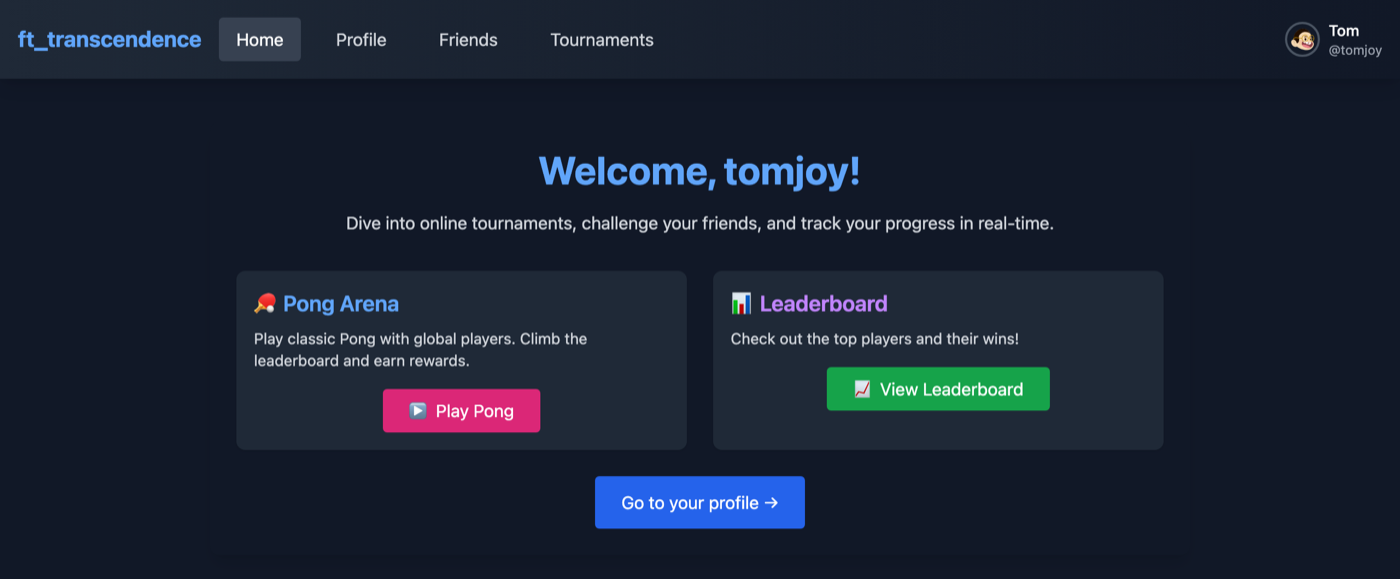
Screens + architectureReal-time multiplayer Pong platform. I built the backend: Fastify REST API, JWT sessions with TOTP two-factor, SQLite persistence, friends, tournaments and match history.
ft_transcendence is the last project of the 42 core curriculum: a single-page application built around real-time multiplayer Pong, with accounts, friends, tournaments and match history around it. It was built by a team of four, each of us owning a distinct area. Mine was the backend — the REST API, its data model, and the authentication in front of both.
The system runs as containers behind nginx, which terminates TLS and splits traffic three ways: REST calls to the Fastify API, WebSocket traffic to the real-time Pong service, and a route to Grafana. The Pong service belonged to one teammate and the containerisation and monitoring stack to another; what concerned me was the boundary between us. The API never touches a frame of gameplay — the Pong service plays the match and posts the result back, so persistence has exactly one entry point.
The API is roughly 2,000 lines of ESM JavaScript over SQLite, organised as domain route modules — public, private, friendships, tournaments, matches — with cross-cutting concerns registered as Fastify plugins. Two parts are worth describing properly.
Users who are half authenticated
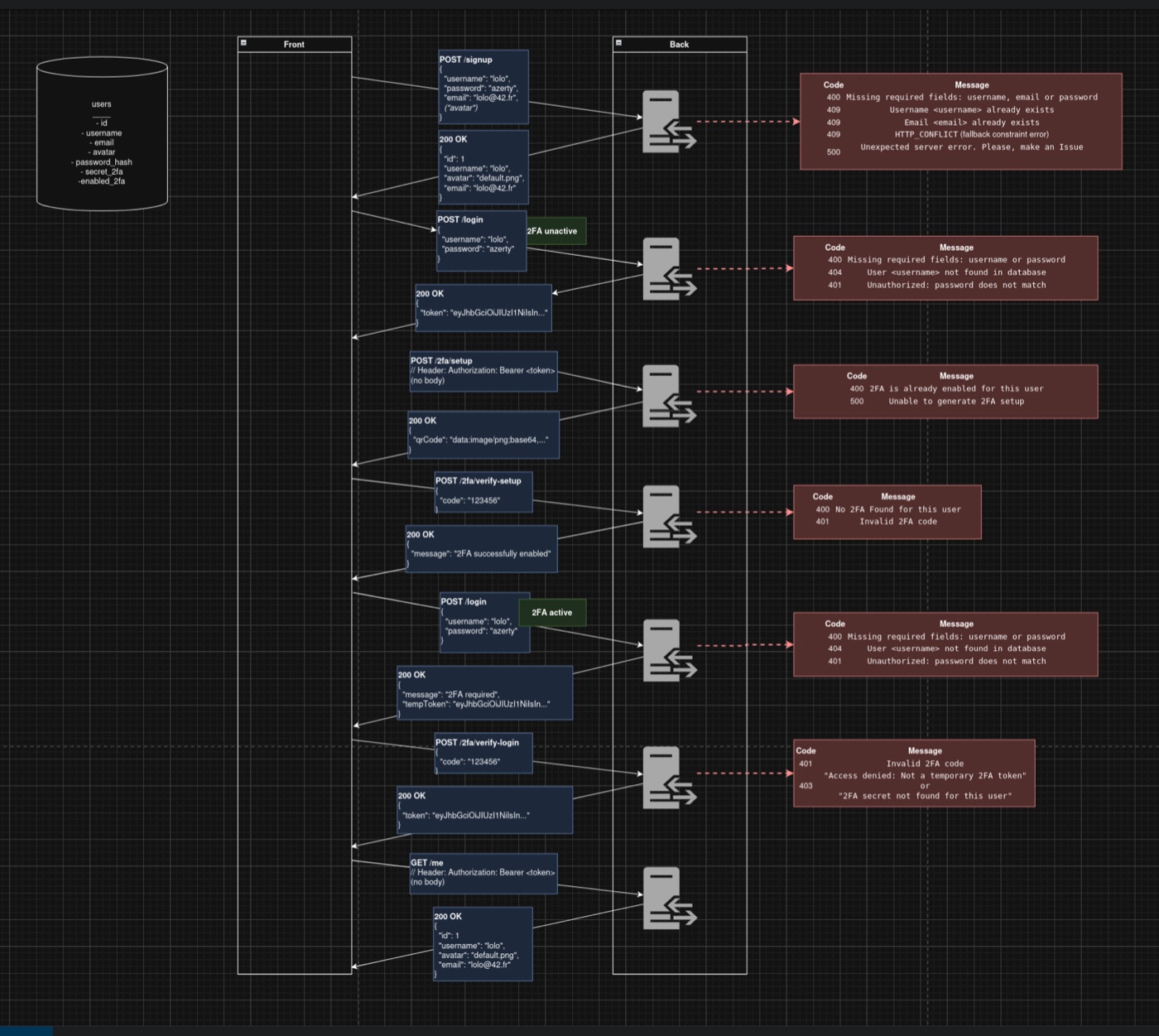
With two-factor enabled, login cannot return a session token. The password is correct, but the second factor has not been presented, so the user is neither anonymous nor authenticated. Every protected endpoint has to refuse them — except the one endpoint that completes the flow.
I put that state in the token itself. Login signs either a normal JWT or, when the account
has 2FA enabled, a temporary one carrying a twofa_pending claim. A single plugin decorates
the request lifecycle: verify the signature, then, if the pending claim is present and the
request is not for /2fa/verify-login, return 403. The rule lives in one place instead of
being restated in every route, and there is no server-side session store to keep consistent
with it.
The trade-off is that a half-authenticated state is now a bearer token the client holds, so it can only be revoked by expiry. I gave that token five hours — far longer than the flow it guards needs. A few minutes is the right number, and it is the first thing I would change.
A bracket is a data structure, not a loop
Tournaments accept any number of players, so the bracket has to absorb sizes that are not
powers of two. Starting a tournament computes ceil(log2(n)) rounds, pads the entry list
with nulls up to the next power of two, and then writes the entire bracket to the
database before a single point is played — every future match row created empty, each one
holding parent_match1_id and parent_match2_id pointers to the two matches that feed it.
Reporting a result then means writing scores to one row and promoting the winner into the parent. No round-generation step, no recomputing the shape from match history, and the frontend can draw the whole bracket immediately because it already exists. The cost is rows for matches that may never be played, and byes that have to be handled as real nulls rather than skipped. I would make the same call again: the shape of a tournament is fixed the moment it starts, so storing it is more honest than deriving it repeatedly.
Elsewhere the work was less interesting but not less necessary — bcrypt password hashing,
regex validation for email and password rules returning 422 rather than a generic failure,
constraint violations translated into specific 409s (username already taken versus email already taken), avatar uploads capped at 2 MB with the multipart error mapped to a 413, and
a small sendError decorator so every failure leaves the API in the same shape.
Where Fract-ol was one person and one loop, this was four application services, four people, and an interface I could not change unilaterally. I worked most closely with the teammate building the frontend: every endpoint I shaped was one they had to consume, so status codes and error shapes were a negotiation rather than my decision. With the other two — the game service and the deployment stack — the contract was the network itself, which is a stricter kind of agreement. That constraint, not the feature list, is what the project taught me.